Posts

The Four Channels of Creative Constraints on RPGs
Image
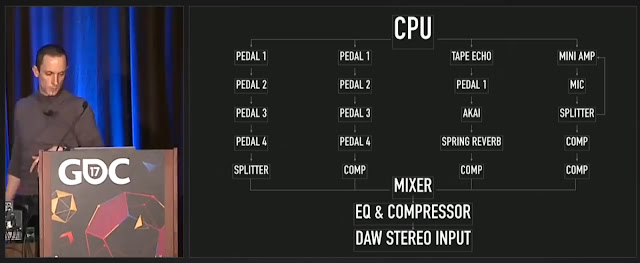
I’ve come up with what I think is an interesting and useful way of thinking about RPGs, but the seeds of it were planted in my head by an unlikely source. I was watching this GDC talk by Mick Gordon about how he created the music for Doom (2016). In it, he describes how his main instrument for the game was a simple sine wave — what he describes as the purest form of sound — filtered through four channels of machines that distort the “pure” sound into something industrial, noisy, and full of character. In a previous post , I described all RPGs as the product of different kinds of “creative constraints” upon play-pretend, which you might call the “purest form” of RPG. I listed various kinds of constraints, but this GDC talk made me think — what if I reorganized those constraints into four channels of distortion? Four channels through which you distort and shape the raw energy of play-pretend into something with a particular character? It turns out it maps pretty well to four channels. S...
Untitled WB:FMAG Hack

Image
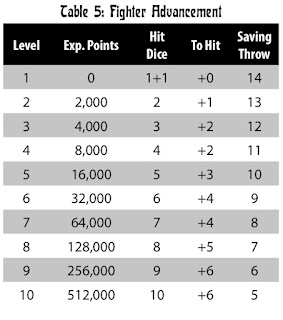
I wrote this little White Box: FMAG hack over the course of the past few hours. I like how Spwack  posts little hacks straight to their blog, so I figured I'd try something similar. I basically just stripped down how Worlds Without Number does ability checks and simplified attacking to one roll. The non-standard attributes, combat order, and Difficult Movement rules come from my big WIP, Goblets & Grues . I might try using this to run OSE adventures and the like, who knows. Character Creation Roll 3d6 for your six attributes: Strength . Climb, swim, jump, push, pull, lift. Dexterity . Keep your balance, perform simple acrobatic stunts. Charisma . Persuade ambivalent NPCs, put on a charming or convincing performance. Craft . Create, tinker, repair, or operate. Stealth . Sneak, hide, perform sleight-of-hand. Survival . Hunt, track, forage, handle animals. Then, roll on whatever table the GM has handy for starting items. Task Resolution If your success at an action is uncertain a...

The Doubling Devil

Image
I. I've been working for a while now on a new game. Confusingly, I'm calling it G&G ( Goblets & Grues ), which is what my failed project from over a year ago was also called. What can I say? I really like the name. This is just a short post about a new mechanic I just added to the draft rules that I'm really excited to try out. So, the idea of this new G&G is to combine a focus on exploration and problem solving with a light emphasis on tactical combat. I miss 5E and how the differentiation of roles in combat makes every player feel important. How to marry these two things? The two approaches seem irreconcilable... "Combat as war" gameplay positions the uncertainty of combat as something to be mitigated or avoided entirely. "Combat as sport" gameplay positions the uncertainty of combat as the heart of the game: the fundamental thing you're supposed to have fun with. II. I would argue that there's a popular game series that has bee...

Setting: The Gyldir Vale

Image
Big hexes are 18 miles, little hexes are 6 miles. I. The Gyldir Vale is a temperate river valley enclosed by the sharp and rocky Red Range to the west; the ancient, forested Green Range to the east; and the magnificent, snow-capped White Range to the north. The valley's name is derived from the Golden Flame, the mysterious source of power with which Rotangur barbarians conquered this land from the high elves 1,000 years ago. The Common Church denounces the Golden Flame as the work of the Devil, but some whisper that the Flame was a gift of divine grace, granted to the Rotangur by the pagan gods of their northern lands. II. 500 years ago, when the kingdom of Gyldria was at the peak of its prosperity, the king's oracle pronounced a vision that the Golden Flame would soon be lost and that the rule of his family would come to an end. Desperate to preserve his rule, the king invited a covetous sorcerer into his court, who promised to study the Flame and uncover the secrets behind it...

RPGs and Creative Constraints: What’s behind the OSR and FKR?

Image
I. Before RPG design became my main hobby, I used to write poetry. My favorite book on my shelf from that time is  The New Book of Forms  by Lewis Turco. It explains the fundamental building blocks of poetry (such as what “iambic pentameter” means) and lists, in encyclopedic fashion, all the notable forms within English poetry. Most modern poetry is free verse, including all the poetry I ever wrote. You put the words together however you think they sound good. There are certain principles to absorb that’ll help you with that, but it’s ultimately up to your intuition of what feels right. It wasn’t always that way. For various historical reasons — because poetry used to be primarily for performance, because it used to be set to music, etc. — poems almost were almost always composed within a particular form, such as the sonnet or the villanelle. To gloss over a lot of history: at a certain point, there was a shift. Poets like Walt Whitman popularized a transition to free verse as...

Some ways I think about TTRPG design

Image
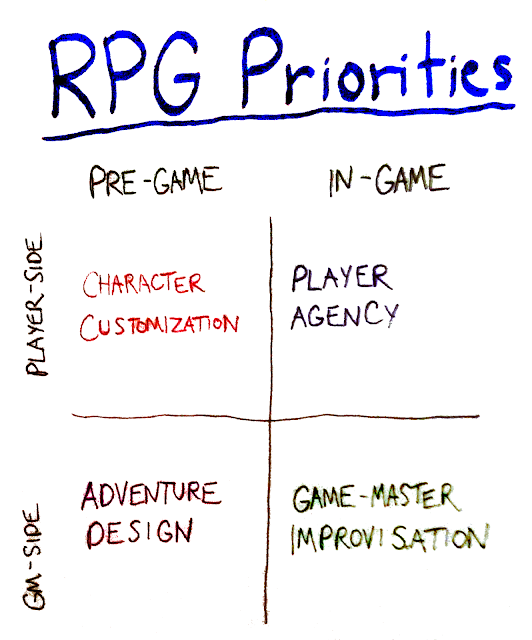
  I. I came up with the chart above some time ago. Originally, I tried to rate individual games' focus on each quadrant on a scale of 1 to 5, but that method arbitrarily relies on comparisons to pre-existing games. Who is to say which game represents a "5 out of 5" focus on Player Agency? Anyway, I still think it's a worthwhile way of thinking about different games in the TTRPG space and what their priorities are. I tend to view Player Agency in terms of  Information-Choice-Impact . How much information are the players given, how free are they to make choices based on that information, and how impactful are those choices in the moment-to-moment gameplay or in the overall scenario? If the answer is "lots of information, very free, and very impactful," the game in question has high Player Agency. Into the Odd  and similar games focus on Player Agency and Adventure Design, but eschew Character Customization and GM Improvisation. By "GM Improvisation" ...

Why do we all have different preferences in RPGs?

Image
welcome to my mountaintop The NSR Discord server is really something unique, I think. For one thing, it's the only server that's got me hanging out regularly! But, more importantly, it has a wide range of people who hail from a wide variety of play cultures. ( This is essential reading if you don't know what I mean by that.) We have a lot of days where those partial to a Culture A and those partial to a Culture B have a conversation along the lines of: CULTURE A PEOPLE : "I just don't get Culture B for reasons X, Y, and Z." CULTURE B PEOPLE : detailed explanation and/or theoretical refutation of X, Y, and Z SOMEONE, EVENTUALLY : "Well, at the end of the day we all have different preferences and that's okay!" Don't get me wrong for a moment: These are often  fantastic conversations , people learn a lot, and some people end up discovering a new style of play that they enjoy. And, yes, we all do have different preferences, and that is okay! Jus...